NEWS
Faucet machining equipments of CNC Machining Centers for Precision Finishing of Bathroom Faucets
Abstract: With the continuous upgrading of the bathroom industry, consumers' requirements for the quality, appearance and performance of bathroom faucets are increasing. As a core link in the production of bathroom faucets, precision finishing directly determines the product's fit, water tightness, service life and aesthetic value. CNC machining centers, as the key equipment for precision finishing of faucets, their precision level is the fundamental guarantee to meet the high-quality requirements of faucet processing. This article deeply explores the precision requirements of CNC machining centers in the precision finishing of bathroom faucets, analyzes the impact of various precision indicators on the processing quality of faucets, and discusses the technical measures to ensure the precision of CNC machining centers. It provides a theoretical and practical reference for the optimization of the faucet processing process and the improvement of product quality.
Keywords: Bathroom faucet; Precision finishing; CNC machining center; Precision requirement; Processing quality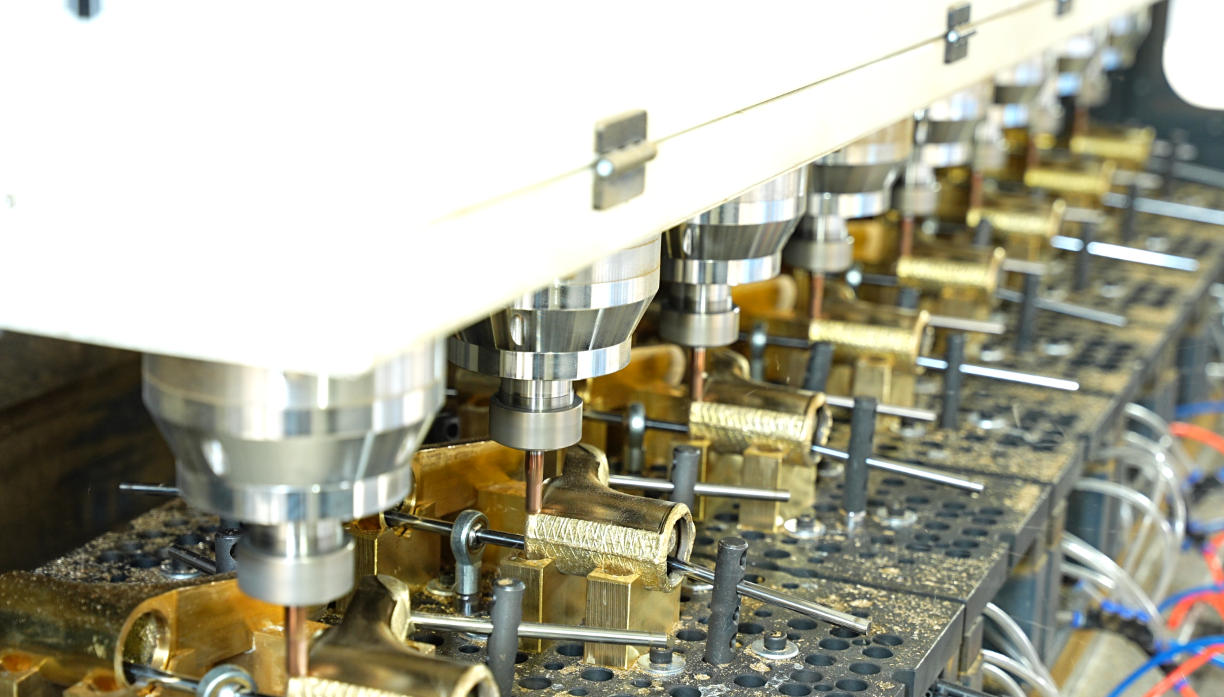
1. Introduction
Bathroom faucets are essential sanitary products in daily life, and their quality is closely related to people's quality of life. In recent years, with the improvement of residents' living standards and the pursuit of a high-quality life, the market's demand for high-end, high-precision bathroom faucets has shown a significant growth trend. Unlike ordinary mechanical parts, bathroom faucets not only need to meet strict functional requirements such as water flow control and leak prevention, but also have high requirements for surface finish, appearance consistency and assembly accuracy. These requirements put forward extremely strict standards for the precision finishing process of faucets.
CNC machining centers, with their high automation, high processing precision and strong processing flexibility, have become the mainstream equipment in the precision finishing of bathroom faucets. Compared with traditional manual processing or ordinary machine tool processing, CNC machining centers can realize complex processing procedures such as milling, drilling, tapping and grinding of faucet workpieces through programmed control, which greatly improves processing efficiency and reduces human errors. However, the processing precision of CNC machining centers is affected by many factors, such as machine tool geometric precision, positioning precision, repeat positioning precision, spindle rotation precision and servo system performance. Any deviation in these precision indicators will be directly reflected in the processed faucet workpieces, leading to problems such as poor assembly, water leakage, uneven surface and short service life. Therefore, clarifying the precision requirements of CNC machining centers for precision finishing of bathroom faucets is of great significance for improving the processing quality of faucets, enhancing market competitiveness and promoting the high-quality development of the bathroom industry.
2. Characteristics of Precision Finishing of Bathroom Faucets
Before discussing the precision requirements of CNC machining centers, it is necessary to first clarify the characteristics of precision finishing of bathroom faucets, which is the basis for determining the corresponding precision indicators. The precision finishing of bathroom faucets mainly has the following characteristics:
2.1 Complex Workpiece Structure
Modern bathroom faucets are designed to be more diverse and personalized, and their structures are becoming increasingly complex. Common faucet structures include single-handle single-hole, double-handle double-hole, thermostatic faucets, etc. The workpieces include valve cores, valve bodies, handles, water outlets and other components. Many of these components have complex internal and external shapes, such as curved surfaces, inclined holes, internal threads and other structures. For example, the valve body of the faucet needs to have precise internal flow channels to ensure smooth water flow and stable water pressure; the handle needs to have a comfortable grip curve and precise connection with the valve core. The complexity of the structure puts forward high requirements for the trajectory accuracy and contour accuracy of the CNC machining center.
2.2 High Requirements for Surface Quality
The surface quality of bathroom faucets is not only related to the aesthetic appearance, but also affects the corrosion resistance and service life of the product. High-end faucets usually require a smooth and flat surface, no burrs, scratches, pits or other defects. For example, the surface roughness of the valve core mating surface needs to reach a very low level to ensure the sealing performance and reduce wear during use. In addition, many faucets need to undergo surface treatment processes such as electroplating and spraying after finishing. The unevenness of the base surface will affect the adhesion and uniformity of the surface treatment layer, leading to problems such as peeling and fading. Therefore, the CNC machining center must ensure high surface finish precision during the finishing process.
2.3 Strict Assembly Precision Requirements
Bathroom faucets are assembled from multiple components, and the assembly precision directly affects the functional performance of the product. For example, the fit between the valve core and the valve body, the fit between the handle and the valve core shaft, and the fit between the water outlet and the valve body all need to meet strict dimensional tolerance requirements. If the dimensional deviation of the processed components is too large, it will lead to loose assembly, stuck movement or poor sealing. In severe cases, the product will be scrapped. Therefore, the CNC machining center must ensure the dimensional accuracy and positional accuracy of each component during processing.
2.4 Diverse Processing Materials
The materials used for bathroom faucets are diverse, including copper alloys (such as brass, red copper), stainless steel, aluminum alloys, etc. Different materials have different physical and mechanical properties, such as hardness, toughness, thermal conductivity and so on. For example, brass has good machinability but relatively low hardness; stainless steel has high hardness and good corrosion resistance but poor machinability. The diversity of materials requires the CNC machining center to have good adaptability, and can adjust the processing parameters according to different materials to ensure processing precision and efficiency.
3. Key Precision Requirements of CNC Machining Centers for Faucet Finishing
Combined with the characteristics of precision finishing of bathroom faucets, the precision requirements of CNC machining centers mainly involve geometric precision, positioning precision, repeat positioning precision, spindle rotation precision and servo system precision. These precision indicators are interrelated and jointly determine the processing quality of faucet workpieces.
3.1 Geometric Precision
Geometric precision is the inherent precision of the CNC machining center, which refers to the precision of the relative position and shape between the main components of the machine tool under no-load conditions. It is the foundation of ensuring processing precision. For faucet finishing, the key geometric precision indicators of the CNC machining center include straightness of guide rails, parallelism, perpendicularity, flatness of the workbench and coaxiality of the spindle.
The straightness of the guide rail directly affects the linear motion precision of the workbench or spindle. If the guide rail has a straightness error, the tool trajectory will deviate during processing, resulting in defects such as curved surfaces or inclined holes of the faucet workpiece. For example, when processing the flow channel of the faucet valve body, if the straightness of the Z-axis guide rail is not up to standard, the drilled hole will be inclined, affecting the water flow performance. The parallelism between the guide rails (such as the parallelism between the X-axis and Y-axis guide rails) affects the plane processing precision of the workpiece. If the parallelism error is too large, the processed plane will be uneven, affecting the assembly of the faucet components.
The perpendicularity between the spindle and the workbench is an important indicator for ensuring the precision of vertical processing. For example, when processing the end face of the faucet handle, if the spindle is not perpendicular to the workbench, the end face will have a tilt error, leading to poor fit with other components. The flatness of the workbench affects the positioning accuracy of the workpiece. If the workbench is uneven, the workpiece will be placed inaccurately, resulting in dimensional deviations during processing. The coaxiality of the spindle affects the precision of rotating processing, such as when processing the outer circle of the faucet valve core. If the spindle coaxiality error is too large, the outer circle will have an oval error, affecting the sealing performance of the valve core.
For the precision finishing of bathroom faucets, the straightness error of the guide rail of the CNC machining center should generally be controlled within 0.01 mm/m, the parallelism error between guide rails within 0.015 mm/m, the perpendicularity error between the spindle and the workbench within 0.02 mm/m, and the flatness error of the workbench within 0.01 mm/m.
3.2 Positioning Precision and Repeat Positioning Precision
Positioning precision refers to the difference between the actual position of the machine tool's moving parts (workbench or spindle) and the theoretical position when moving to a specified position. Repeat positioning precision refers to the degree of consistency of the actual positions when the moving parts move to the same specified position multiple times. These two precision indicators are crucial for ensuring the dimensional accuracy and consistency of faucet workpieces, especially for batch processing.
In the precision finishing of faucets, many processing procedures require the tool to move to a precise position for processing. For example, when drilling the mounting holes of the faucet valve body, the positioning accuracy of the X-axis and Y-axis directly determines the position of the holes. If the positioning accuracy is not up to standard, the distance between the holes will deviate from the design requirements, leading to failure to assemble with other components. Repeat positioning precision is particularly important for batch processing. If the repeat positioning precision is poor, the dimensional deviation between different workpieces will be large, resulting in inconsistent product quality. For example, when processing a batch of faucet handles, if the repeat positioning precision of the CNC machining center is not good, some handles will have excessive dimensional deviations and cannot be matched with the valve core.
At present, for the CNC machining centers used in faucet precision finishing, the positioning accuracy of the linear axes (X, Y, Z axes) should generally be controlled within ±0.005 mm, and the repeat positioning accuracy within ±0.003 mm. For high-precision faucet components (such as valve cores), the positioning accuracy and repeat positioning accuracy need to be further improved, reaching ±0.003 mm and ±0.002 mm respectively.
3.3 Spindle Rotation Precision
The spindle is the core component of the CNC machining center that drives the tool to rotate. Its rotation precision directly affects the surface finish and dimensional accuracy of the workpiece. The rotation precision of the spindle is mainly reflected in the radial runout and axial runout of the spindle.
Radial runout refers to the deviation of the spindle axis from its ideal rotation axis in the radial direction. It will cause the tool to swing during rotation, resulting in uneven cutting and affecting the surface finish of the workpiece. For example, when milling the outer circle of the faucet water outlet, if the spindle has a large radial runout, the outer circle surface will have waviness, affecting the aesthetic appearance and assembly precision. Axial runout refers to the deviation of the spindle axis in the axial direction during rotation. It will affect the depth precision of processing, such as when tapping the internal thread of the faucet. If the axial runout is too large, the depth of the thread will be inconsistent, affecting the connection firmness.
For faucet precision finishing, the radial runout of the spindle of the CNC machining center should be controlled within 0.002 mm, and the axial runout within 0.001 mm. In addition, the spindle speed stability also affects the processing precision. The spindle should be able to maintain a stable speed during processing, avoiding speed fluctuations that cause uneven cutting force and affect the surface quality of the workpiece.
3.4 Servo System Precision
The servo system is the executive component of the CNC machining center, which is responsible for converting the numerical control program into the mechanical motion of the machine tool. The precision of the servo system directly affects the dynamic response speed and positioning precision of the machine tool. For faucet precision finishing, the servo system needs to have high positioning accuracy, fast dynamic response and good stability.
The dynamic response speed of the servo system determines the ability of the machine tool to track the tool trajectory. For the processing of complex curved surfaces of faucet workpieces (such as the handle curve), the servo system needs to quickly respond to the program instructions to ensure that the tool can accurately follow the theoretical trajectory. If the dynamic response is slow, the tool will lag behind the program instructions, resulting in contour deviation of the curved surface. The stability of the servo system affects the processing stability. If the servo system is unstable, vibration will occur during processing, leading to burrs or scratches on the surface of the workpiece.
To meet the precision requirements of faucet finishing, the servo system of the CNC machining center should adopt high-precision encoders (such as absolute encoders with a resolution of more than 1 million pulses/rev) to improve the positioning accuracy. At the same time, it should have advanced control algorithms (such as PID control, fuzzy control) to optimize the dynamic performance and stability of the system.
4. Factors Affecting the Precision of CNC Machining Centers in Faucet Finishing
In addition to the inherent precision of the CNC machining center itself, there are many external factors that will affect the processing precision during the faucet finishing process. These factors mainly include workpiece clamping, tool selection and wear, processing parameters, ambient temperature and human factors.
4.1 Workpiece Clamping
The clamping of the workpiece is the first step in processing. If the clamping is inaccurate or unstable, it will directly lead to processing errors. For faucet workpieces with complex shapes, it is necessary to use special fixtures to ensure the positioning accuracy and clamping stability. If the fixture has poor precision or the clamping force is uneven, the workpiece will shift or deform during processing. For example, when clamping the faucet valve body, if the fixture's positioning surface is not flat, the valve body will be tilted, resulting in dimensional deviations in the processed holes and surfaces. In addition, excessive clamping force will cause elastic deformation of the workpiece, and the deformation will recover after clamping is released, leading to processing errors.
4.2 Tool Selection and Wear
Tools are the direct components that contact the workpiece and complete the cutting process. The selection of tools and their wear conditions have a significant impact on processing precision. For different faucet materials and processing procedures, appropriate tools should be selected. For example, when processing stainless steel faucets, cemented carbide tools with high hardness and wear resistance should be used; when processing brass faucets, high-speed steel tools can be used to improve processing efficiency. If the tool type is selected incorrectly, it will lead to poor cutting performance, affecting the surface quality and dimensional accuracy of the workpiece.
Tool wear is an inevitable phenomenon during processing. With the increase of processing time, the tool tip will wear, leading to an increase in cutting force and a decrease in processing precision. For example, when the milling tool is worn, the processed surface will become rough, and the dimensional deviation will increase. Therefore, during the faucet finishing process, it is necessary to regularly check the tool wear status and replace the tool in time to ensure processing precision.
4.3 Processing Parameters
Processing parameters (such as cutting speed, feed rate, cutting depth) have an important impact on processing precision and surface quality. Improper selection of processing parameters will lead to problems such as tool vibration, workpiece deformation and poor surface quality. For example, if the cutting speed is too high, the tool will wear quickly, and the workpiece may be heated and deformed; if the cutting speed is too low, the processing efficiency will be reduced, and the surface may have burrs. If the feed rate is too large, the cutting force will increase, leading to workpiece deformation; if the feed rate is too small, the processing time will be prolonged, and the surface finish may be affected.
Therefore, for different faucet materials and processing procedures, it is necessary to optimize the processing parameters. Through experiments and practice, the optimal combination of cutting speed, feed rate and cutting depth is determined to ensure processing precision and efficiency.
4.4 Ambient Temperature
The ambient temperature has a significant impact on the precision of CNC machining centers. The main components of the machine tool (such as guide rails, spindle, lead screws) are affected by temperature changes, which will cause thermal expansion and contraction, leading to changes in geometric precision. For example, when the ambient temperature rises, the lead screw will elongate, leading to positioning errors; the spindle will expand thermally, affecting the rotation precision. In addition, the temperature difference between the workpiece and the machine tool will also cause thermal deformation of the workpiece, affecting processing precision.
To reduce the impact of ambient temperature on processing precision, the faucet processing workshop should maintain a stable temperature. Generally, the ambient temperature should be controlled between 18°C and 22°C, and the temperature fluctuation should not exceed ±1°C. At the same time, the machine tool should be preheated before processing to make the temperature of each component stable, reducing the impact of thermal deformation on precision.
4.5 Human Factors
Human factors also play an important role in the precision of CNC machining centers. The technical level and operational proficiency of the operator directly affect the processing quality. For example, if the operator's programming level is not high, there will be errors in the CNC program, leading to processing deviations; if the operator does not accurately install the workpiece and tool, it will affect the positioning accuracy. In addition, the operator's lack of maintenance awareness of the machine tool will lead to a decrease in the precision of the machine tool over time.
Therefore, it is necessary to strengthen the training of operators, improve their technical level and operational proficiency. At the same time, establish a sound machine tool maintenance system, and regularly maintain and calibrate the CNC machining center to ensure its long-term stable precision.
5. Technical Measures to Ensure the Precision of CNC Machining Centers for Faucet Finishing
To meet the precision requirements of bathroom faucet finishing, in addition to selecting high-precision CNC machining centers, a series of technical measures should be taken to ensure the stability and reliability of processing precision. These measures mainly include machine tool precision calibration, fixture optimization, tool management, processing parameter optimization and quality inspection.
5.1 Machine Tool Precision Calibration
Regular precision calibration of CNC machining centers is an important means to ensure processing precision. With the long-term use of the machine tool, the precision of its components will gradually decrease due to wear, deformation and other reasons. Therefore, it is necessary to establish a regular calibration system to calibrate the geometric precision, positioning precision and repeat positioning precision of the machine tool. The calibration work should be carried out by professional technicians using high-precision measuring instruments (such as laser interferometers, ball bars, dial gauges). For the indicators that do not meet the requirements, timely adjustment and maintenance should be carried out, such as adjusting the guide rail clearance, tightening the lead screw, and compensating the servo system.
5.2 Fixture Optimization
Optimizing the fixture design and clamping method is an important measure to improve the positioning accuracy and stability of the workpiece. For faucet workpieces with complex shapes, special fixtures should be designed according to the structural characteristics of the workpiece. The fixture should have high positioning precision and clamping stability. For example, when processing the faucet valve body, a positioning fixture based on the inner hole or outer circle can be used to ensure the coaxiality of the processed holes and surfaces. At the same time, the clamping force should be reasonably controlled to avoid workpiece deformation. The use of hydraulic or pneumatic clamping devices can realize uniform clamping force and improve clamping stability and efficiency.
5.3 Tool Management
Strengthening tool management is an important guarantee to ensure processing precision. A complete tool management system should be established, including tool selection, storage, use, wear detection and replacement. Before processing, according to the material and processing procedure of the faucet workpiece, the appropriate tool type, material and geometric parameters should be selected. During storage, the tools should be placed in a dry and clean environment to avoid rust and damage. During use, the tool wear status should be regularly checked. The use of tool wear monitoring systems can realize real-time monitoring of tool wear and automatically prompt replacement when the wear reaches a certain limit. In addition, the tool should be pre-adjusted before installation to ensure the accuracy of the tool length and radius compensation.
5.4 Processing Parameter Optimization
Optimizing the processing parameters is an effective way to improve processing precision and efficiency. The optimization of processing parameters can be carried out through experiments and simulation. First, according to the material and processing procedure of the workpiece, a preliminary range of processing parameters is determined. Then, through a large number of processing experiments, the influence of different parameters on processing precision and surface quality is analyzed, and the optimal parameter combination is obtained. With the development of intelligent manufacturing technology, the use of adaptive control systems can realize real-time adjustment of processing parameters according to the actual processing conditions (such as tool wear, cutting force changes), ensuring the stability of processing precision.
5.5 Quality Inspection
Strengthening the quality inspection of the processed workpieces is the last line of defense to ensure the processing quality. A complete quality inspection system should be established, including incoming inspection of raw materials, in-process inspection and final inspection. In the process of faucet finishing, in-process inspection should be carried out for key procedures and key dimensions. For example, after processing the valve core mating surface, the surface roughness and dimensional accuracy should be measured in time. If problems are found, the processing parameters or machine tool precision should be adjusted in time. The final inspection should be carried out for the finished faucet workpieces, including dimensional accuracy, surface quality, assembly performance and water tightness. High-precision measuring instruments (such as coordinate measuring machines, surface roughness meters) should be used for inspection to ensure the accuracy and reliability of the inspection results.
6. Conclusion
The precision finishing of bathroom faucets has the characteristics of complex workpiece structure, high surface quality requirements, strict assembly precision requirements and diverse processing materials. CNC machining centers, as the key equipment for faucet finishing, their precision level directly determines the processing quality of faucets. The key precision requirements of CNC machining centers for faucet finishing include geometric precision, positioning precision, repeat positioning precision, spindle rotation precision and servo system precision.
In the actual processing process, the precision of CNC machining centers is affected by many factors such as workpiece clamping, tool selection and wear, processing parameters, ambient temperature and human factors. To ensure processing precision, it is necessary to take a series of technical measures, including regular machine tool precision calibration, fixture optimization, tool management, processing parameter optimization and strict quality inspection.
With the continuous development of the bathroom industry and the continuous progress of CNC machining technology, the precision requirements of CNC machining centers for faucet finishing will be higher and higher. In the future, by integrating advanced technologies such as intelligent control, precision measurement and digital simulation, the precision and intelligence level of CNC machining centers will be further improved, which will provide a stronger guarantee for the high-quality development of the bathroom faucet industry.